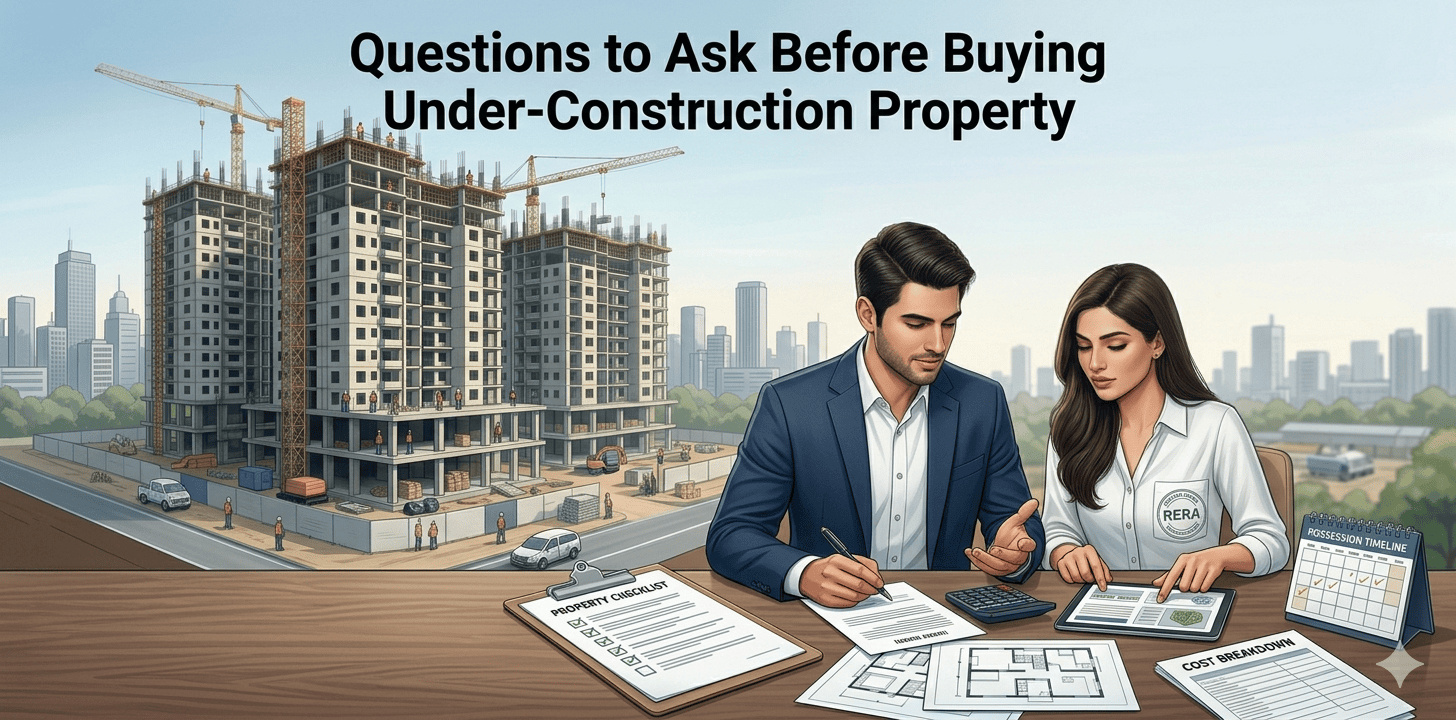
Questions to Ask Before Buying Under-Construction Property
Buying an under-construction home can look like a smart move at first glance. The entry price may feel more attractive than a ready-to-move flat, the payment plan may seem flexible, and the promise of future appreciation can be tempting. But the real decision should never be based on price alone. The smartest buyers know that the outcome depends on the questions asked before the booking amount is paid.
That is exactly why understanding the right questions to ask before buying under-construction property matters so much. If you ask the right things early, you reduce the chances of delay, legal confusion, cost escalation, layout mismatch, or possession-related disappointment. If you skip them, even a good-looking project can turn into a stressful commitment.
This is also where regulation becomes important. Under RERA, real estate projects generally need registration before they can be offered for sale, and Haryana RERA provides public project-search access for buyers. The central RERA framework also requires 70% of the money collected from buyers to be deposited into a separate escrow account for that specific project, which makes payment-related questions especially important.
Whether you are a first-time homebuyer, an investor, or someone upgrading to a larger home, this guide will help you ask sharper questions, compare projects more confidently, and avoid costly mistakes.
Why These Questions Matter Before You Book
Under-construction property is not just a product. It is a promise. You are paying today for something that will be delivered tomorrow. That means your money is tied not only to the quality of the apartment, but also to the builder’s credibility, approvals, execution capability, financial discipline, and communication standards.
Many buyers make one common mistake: they ask about amenities, discounts, and possession dates, but they do not ask about the documents, timelines, cost structure, escalation triggers, or delivery terms hidden inside the agreement. That is where most real trouble begins.
Asking better questions helps you:
- verify the project legally
- understand the real cost, not just the headline price
- judge whether the builder’s promise is realistic
- spot red flags before you commit
- protect your down payment and loan planning
- choose a home that fits both your budget and timeline
In Haryana, the legal side matters even more because the regulatory framework is built around buyer protection, transparency, registered projects, and project-level financial compliance. Haryana RERA’s public systems and the central RERA rules are designed to help buyers verify more than just marketing claims.
Quick Snapshot – The Most Important Questions to Ask
| Question Area | What You Should Ask | Why It Matters |
| RERA Status | Is the project registered and what is the registration number? | Confirms legal visibility and buyer protection |
| Approvals | Are all key approvals in place? | Reduces legal and construction risk |
| Builder Track Record | What has the builder delivered before, and on time? | Helps judge execution reliability |
| Payment Plan | Is payment linked to construction progress? | Protects cash flow and reduces exposure |
| Carpet Area | What is the exact carpet area I am paying for? | Prevents confusion around usable space |
| Possession Timeline | What is the realistic possession date and grace period? | Helps plan rent, loan, and move-in timing |
| Total Cost | What is the all-inclusive cost sheet? | Avoids last-minute surprises |
| Specifications | What exactly will be delivered in the flat? | Prevents mismatch with sample flat promises |
| Infrastructure | What will be functional by possession? | Helps assess real livability |
| Exit/Delay Clauses | What happens if the project is delayed or I cancel? | Important for financial safety |
Legal Questions – Start with Project Legitimacy
1. Is the project registered under RERA?
This should be your first question, not your fifth. If the answer is vague, delayed, or verbally “assured” without documentation, that is a warning sign. A registered project is easier to verify, easier to track, and easier to question if there is a future dispute.
Ask for:
- the project’s RERA registration number
- the exact phase registered, if it is a multi-phase township
- the official project name used in registration
- whether the tower you are considering falls under the same registration
This is not a formality. Projects generally need to be registered with the relevant state RERA before being offered for sale, and Haryana RERA provides a public project search function and registered project listings that buyers can review.
2. Can I see the approved plans and statutory clearances?
A buyer should never rely only on brochures or the sample flat. Ask whether the sanctioned building plan, layout approval, land title clarity, and essential permissions are available for inspection. You do not need to become a lawyer, but you do need to know whether the foundation of the project is clean.
Useful follow-up questions:
- Has the layout changed since launch?
- Are all towers approved or only selected ones?
- Are environmental and local authority approvals in place?
- Are there any pending litigations or restrictions?
This question protects you from buying into uncertainty disguised as a launch opportunity.
3. Will the sale be based on carpet area or confusing area terms?
This question sounds technical, but it directly affects value. Buyers often focus on the total quoted size without understanding how much usable area they are actually getting inside the home.
Haryana RERA has specifically issued rules around sale of apartments in a real estate project on the basis of carpet area, and the Haryana framework for ongoing projects requires promoters to reveal apartment size based on carpet area even if units were earlier sold on other bases.
So, ask clearly:
- What is the carpet area?
- What is the total chargeable area?
- What part of the quoted size is actually usable inside the apartment?
- Are balconies, utility areas, and common loading explained separately?
A serious builder should answer this without hesitation.
4. When will the agreement for sale be signed?
Many buyers pay a sizable booking amount and then wait too long for the formal agreement. That is risky. Haryana’s project registration regulations state that before receiving any amount more than 10% of the apartment price, an agreement should be executed.
That makes this an essential buyer question:
- How much am I expected to pay before the agreement?
- When exactly will the agreement be executed?
- Can I review the draft before making a larger payment?
- Are the terms negotiable or fixed?
This one question can save you from stepping into a one-sided transaction.
Builder Questions – Who Is Actually Delivering This Project?
5. What is the builder’s real delivery history?
A polished brand deck is not the same as a delivery record. Ask what the developer has completed in the last five to seven years, how those projects were handed over, and whether earlier buyers faced major delays or layout changes.
Look beyond the sales pitch and ask:
- How many projects has the builder completed?
- Which ones were delivered close to schedule?
- How many are still delayed?
- Are maintenance quality and after-sales service strong?
A builder’s past behavior is often the best preview of your future experience.
6. Is this a first phase, later phase, or part of a larger township?
This matters more than many buyers realize. In township projects, one phase may be ready on time while another waits for roads, retail, landscape zones, or common amenities. If you buy too early without asking the right questions, you may receive your flat but still live in a construction environment.
Ask:
- Which phase is being sold right now?
- What will be complete by the time possession is offered?
- Will club, retail, roads, and security systems be operational together?
- Will nearby towers still be under heavy construction?
This gives you a more realistic idea of liveability, not just possession on paper.
Cost Questions – What Will You Actually Pay?
7. What is the all-inclusive cost, not just the basic sale price?
This is one of the most important questions to ask before buying under-construction property, because the base price is rarely the final price. Buyers often discover extra charges only when the demand letters start arriving.
Ask for a full written cost sheet covering:
- basic sale price
- floor rise charges
- PLC or preferential location charges
- club membership
- parking
- maintenance deposit
- power backup or utility connection charges
- legal or documentation charges
- government charges at the time of registration
You are not just asking for transparency. You are testing whether the builder is comfortable being transparent.
8. Is the payment plan construction-linked or time-linked?
A time-linked plan may look simply, but it shifts more risk to the buyer. A construction-linked plan is usually easier to evaluate because payments move with visible progress.
This question matters even more because the RERA framework requires 70% of the money collected from buyers to be deposited in a separate bank account for construction of that specific project, with withdrawals subject to certification.
Ask:
- What milestone triggers each payment?
- Who certifies construction progress?
- Can I see the construction stage before each demand?
- What happens if work slows but payments continue?
If the answer is vague, keep digging.
9. Are there escalation clauses or open-ended future charges?
Some buyers focus so much on discount negotiations that they forget to ask about future cost movement. Even when the price looks fixed, there may be clauses linked to taxes, external development charges, infrastructure charges, or statutory revisions.
Ask directly:
- Is the quoted price fully fixed?
- Which charges can change later?
- What is the builder not locking in today?
- Are there any hidden possession-stage charges?
Clarity here protects your budget and your home loan planning.
Construction Questions – Will the Home Actually Be Delivered As Promised?
10. What is the committed possession date and what counts as delay?
Every under-construction buyer should ask this in writing, not in conversation. Possession is not just a marketing timeline. It is a financial event that affects rent, EMIs, family planning, school admissions, and relocation decisions.
Ask:
- What is the committed possession date?
- Is there a grace period?
- Is that date for possession, offer of possession, or completion?
- What compensation applies in case of delay?
- Does possession mean the flat is usable or only structurally ready?
These distinctions matter.
11. What is the current stage of construction today?
You do not want a generic answer like “work is going on fast.” You want specifics.
Ask for:
- latest construction photographs
- tower-wise stage update
- slab completion status
- MEP and finishing stage details
- expected timeline for internal works and common areas
Then compare the answer with what you see on site. If the physical progress and the promised timeline do not match, treat that as a serious red flag.
12. Who is responsible for construction quality and defects after handover?
Most buyers ask about finishes, but fewer ask what happens if there are seepage issues, cracks, poor fittings, or defective work after possession.
Ask:
- What is the defect liability support process?
- How long will issues be attended after handover?
- Who handles snagging complaints?
- Is there a formal handover checklist?
A builder that speaks clearly about post-handover quality usually inspires more confidence than one that only talks about brochures and amenities.
Apartment Questions – What Will You Actually Receive?
13. What exactly is included in the delivered flat?
Do not assume the sample flat is the final standard. Sample units are designed to impress, not always to reflect the exact delivered product.
Ask for a written specification sheet that covers:
- flooring type
- doors and windows
- kitchen finish
- bathroom fittings
- electrical points
- AC provision
- wardrobe or modular inclusions, if any
- wall finish and paint standard
This helps prevent disappointment on possession day.
14. Can the layout, views, or unit plan change later?
A buyer should know whether the builder reserves the right to make changes in tower orientation, common areas, or apartment layout. Some changes may be minor, but others may affect ventilation, view, privacy, or even usable space.
Ask:
- Can tower spacing change?
- Can the layout be revised?
- Can amenity locations shift?
- What approval is needed before changes are made?
The goal is not to become suspicious. It is to understand your protection before something changes.
Location Questions – How Livable Will It Be When You Move In?
15. What will the surrounding infrastructure actually look like by possession?
A project can be sold on future potential, but you will live in present reality. So ask what will realistically be functional by the time you get the keys.
Good questions include:
- Will approach roads be complete?
- How far are the nearest daily convenience options?
- What schools, hospitals, and work hubs are practically accessible?
- Is the project dependent on future infrastructure for its main value?
The difference between “planned location” and “working location” is often huge.
16. Is this home right for end use, investment, or only long waiting?
Some under-construction projects are best for long-term investors. Others are better for genuine end-users. Buyers get into trouble when they purchase with one objective but the project suits another.
Ask yourself and the seller:
- Is rental demand likely by possession?
- Is this micro-market already established or still emerging?
- Does the project suit family living, investor holding, or both?
- How dependent is future appreciation on external infrastructure?
A smart decision is not just about whether the project is good. It is about whether it is right for your purpose.
Buyer Decision Table – Questions by Priority
| Priority Level | Question | Why It Should Come Early |
| Must Ask First | Is the project RERA-registered? | It is the legal baseline |
| Must Ask First | What is the all-inclusive cost? | Budget decisions depend on it |
| Must Ask First | When is the agreement for sale signed? | Protects your early payments |
| High Priority | What is the carpet area? | Defines actual usable value |
| High Priority | What is the payment plan? | Direct impact on cash flow |
| High Priority | What is the committed possession date? | Affects rent, EMI, and planning |
| Important | What has the builder delivered before? | Helps judge credibility |
| Important | What is included in the flat? | Prevents mismatch and disputes |
| Important | What infrastructure will be ready by handover? | Shapes real livability |
| Important | What happens in case of delay or cancellation? | Key for risk control |
FAQs – Questions to Ask Before Buying Under-Construction Property
1. What is the first question to ask before buying under-construction property?
The first question should be whether the project is properly registered and verifiable under the relevant RERA authority. That gives you a legal starting point before discussing price or amenities.
2. Why is carpet area more important than just flat size?
Because carpet area helps you understand the actual usable space inside the apartment. It is far more meaningful than broad size claims that include non-usable components. Haryana RERA has specific directions around sale disclosures based on carpet area.
3. Can a builder take a large booking amount before the agreement is signed?
A buyer should be very cautious here. Haryana’s regulatory framework states that before receiving more than 10% of the apartment price, an agreement should be executed.
4. Why should I ask about the payment plan in detail?
Because a poorly structured plan can expose you to unnecessary financial stress. RERA’s escrow requirement makes project-linked payment discipline an important question for buyers.
5. Are under-construction properties always cheaper than ready-to-move homes?
Not necessarily in final effect. They may offer lower entry pricing in some cases, but the real comparison depends on time value, rent outflow, possession certainty, and total cost structure.
6. What should I ask about possession?
Ask for the committed possession timeline, any grace period, the definition of delay, and whether common areas and essential services will also be ready when possession is offered.
7. Should I rely only on the sales team’s verbal assurances?
No. Important details should always be checked in the official registration record, cost sheet, and agreement documents. That is the safest way to avoid confusion later.
Expert Insight
The biggest mistake buyers make with under-construction property is assuming that a good brand automatically means a low-risk decision. In reality, the strength of the decision comes from the quality of questions you ask before booking. Legal status, payment structure, carpet area clarity, and delivery terms matter far more than launch-day excitement.
From a practical market perspective, the best under-construction purchase is usually the one where the buyer understands not just the project promise, but the project process. Experienced advisors such as Sapient Realty often help buyers filter that process more carefully by focusing on approvals, cost transparency, and delivery realism before money is committed.
Real Buyer Scenario
Imagine a buyer comparing two under-construction 3 BHK projects in the same corridor. The first project offers a lower launch price, but gives vague answers on approvals, phase readiness, and possession timing. The second project is slightly higher in price, but the builder shares a clear RERA registration number, tower-specific progress, a construction-linked plan, and a written specification list.
At first, the cheaper option appears more attractive. But once the buyer asks the right questions, the second project becomes the better decision because the risk is easier to understand and the total commitment is more transparent. That is the real power of asking sharper questions before booking.
Conclusion
Choosing an under-construction home is not just about finding a good project. It is about asking the right questions before you become financially committed. That is what separates a confident buyer from an exposed one.
If you remember only one thing from this guide, let it be this: never book based only on price, brochure design, or a verbal possession promise. Ask about registration, approvals, carpet area, agreement timing, payment structure, actual cost, delivery responsibility, and infrastructure readiness. Those questions do more than protect your money. They protect your timeline, your expectations, and your peace of mind.
If you are seriously evaluating a project, make a written checklist and use it in every meeting. It will instantly improve the quality of your decision. And if you need experienced support in sorting through approvals, cost sheets, or project-stage clarity, Sapient Realty can help bring more structure to the process.