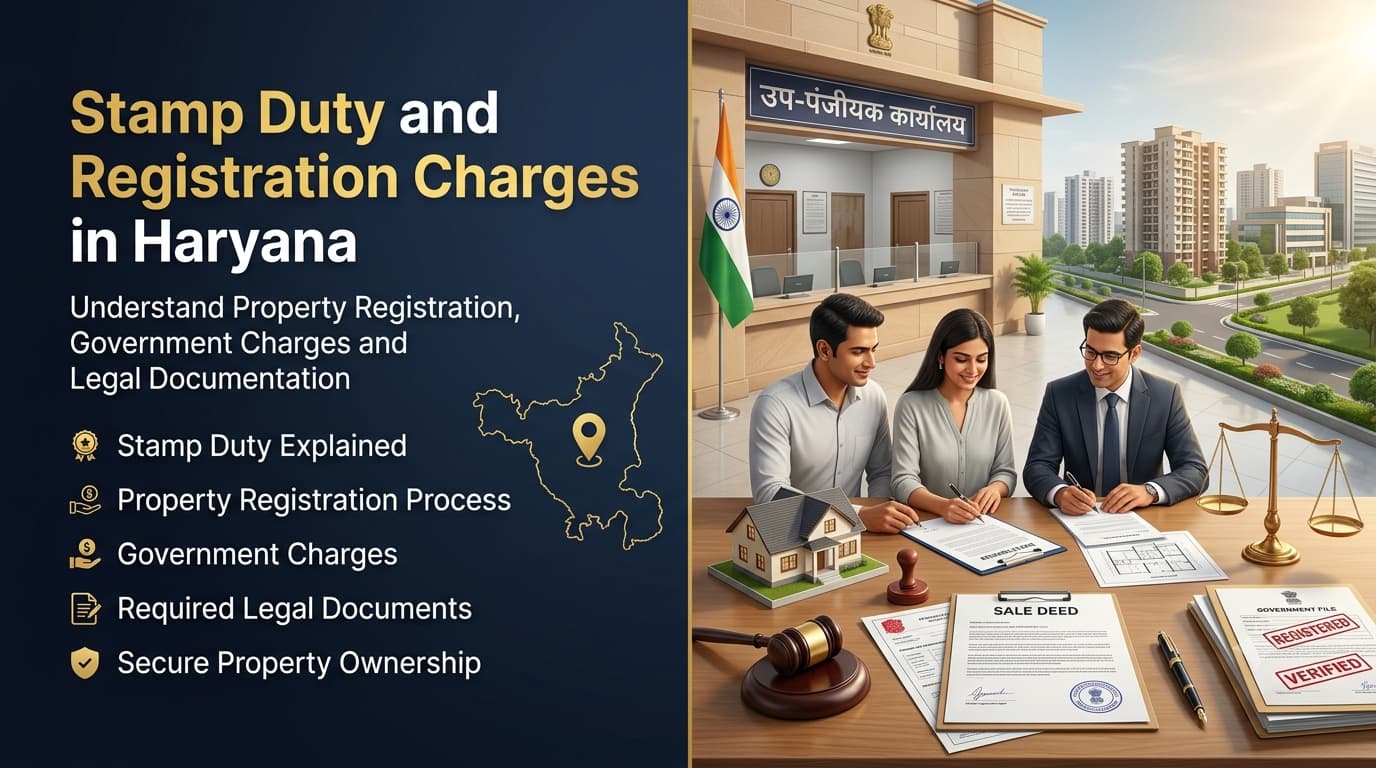
Stamp Duty and Registration Charges in Haryana
Last Updated: July 11, 2026
Stamp Duty and Registration Fees in Haryana are key expenses that every property purchaser must be aware of before purchasing a residential, commercial, or agricultural property. Stamp duty and registration fees are key expenses in the process of property registration and they assist in ensuring the proper registration of property. While many buyers pay a lot of attention to the value of a particular property, they overlook other charges that might occur in the process of completing the deal, which will make future financial planning more complicated. Knowledge about stamp duty, registration fee, document requirements and registration process will help you to prepare properly for the transaction and conclude it successfully.
The current guide contains all the information that is needed for understanding the whole process, as it is explained in the simplest way possible. It is especially helpful for first-time property buyers, investors and property owners who do not know much about the whole process yet.
Understanding Stamp Duty and Registration Charges
Even though these two taxes are commonly referred to together, they play different roles in a property transaction. The stamp tax is a tax paid by the government to ensure that the transaction of the property is done legally as per the rules of law. On the other hand, the registration tax is the amount collected by the government as a means of recording the transaction of property with the relevant government department. It is vital to note that both stamp and registration taxes play a significant role in ensuring the legality of the transactions of properties. Failure to fulfill the required formalities may lead to problems in proving ownership of property in the future. Therefore, it will be easier for the buyer to plan accordingly and avoid complications while registering the property.
Quick Comparison of Stamp Duty and Registration Charges
The table below provides a simple comparison to help buyers understand the purpose and importance of both charges during a property transaction.
| Feature | Stamp Duty | Registration Charges |
| Purpose | Makes the property transaction legally valid | Records the ownership transfer in official government records |
| Paid To | State Government | Registration Authority |
| Applicable During | Before or at the time of property registration | During property registration |
| Legal Importance | Supports the legal validity of the transaction | Establishes the official ownership record |
| Required For | Property purchase, transfer, or other applicable transactions | Completion of property registration |
| Future Benefit | Helps strengthen legal documentation | Provides recognised proof of ownership through registered records |
Why Both Charges Are Important
Stamp duty and registration charges are two charges which complement each other in fulfilling the legal requirements of the transfer of ownership from the seller to the buyer of a property. Payment of only one of these fees cannot fulfill the legal requirement of the entire process as these two serve a different purpose in the process of registration. Upon completing the formalities as per the process, the transfer of ownership gets officially recorded in the government records. Proper payment of these fees can help in conducting further activities including sale of the property, verifying ownership, inheritance of the property, and any activity which requires ownership documentation. This way, buyers can view these fees as part of the process of buying a property rather than just another formality.
Current Stamp Duty and Registration Charges in Haryana
The stamp duty and registration charges in Haryana may differ depending on a number of considerations including but not limited to the kind of property being purchased, the location of the same, the kind of deal involved, and government rules and policies that apply. As these rates are revised from time to time in government notifications, buyers should make sure that they have the correct rate in order to make necessary payment while dealing in any property purchase. Rather than sticking to old figures which may turn out to be incorrect, it would be better for the buyer to check for the current applicable rate with the concerned registration authority.
Indicative Applicability of Stamp Duty and Registration Charges
| Property Category | Stamp Duty | Registration Charges |
| Residential Property | Applicable as per government rules | Applicable |
| Commercial Property | Applicable as per government rules | Applicable |
| Agricultural Land | Applicable wherever required | Applicable where registration is required |
| Urban Property | Applicable according to prevailing regulations | Applicable |
| Rural Property | Applicable according to prevailing regulations | Applicable |
Note: The applicable about registration charges may change through government notifications. Buyers should verify the latest rates with the concerned registration authority before completing any property transaction.
Factors That Affect Stamp Duty in Haryana
A number of elements come into play when deciding the stamp that would be applicable during a property transaction, which means that the amount of stamp duty might be different for one property from another. These elements include the location of the property, i.e. whether the property is located in an urban or rural setting. The nature of the property is also critical. This might be a residential, commercial, industrial, or agricultural property. Furthermore, the ownership pattern, the transaction specifics, and the government policy on stamp at the time of purchase will also have their say in the stamp to be paid.
How Stamp Duty is Calculated
Stamp duty is usually determined using the rules provided by the government depending on the value of the property’s transaction value, circle rate notified, or any other valuation method stipulated by the competent authority. In most cases, the higher value will be used in the calculation. It is important for buyers to note that the transaction value stated does not necessarily mean that it will always be used in the calculation. Checking the circle rate, and the property values before registration, will help in ensuring the calculation process is done correctly. Valuation methods may change with time, and buyers should, therefore, check the current guidelines from the government.
Registration Charges in Haryana
The fees for registration are levied for the purpose of recording the change in ownership of the property in the official record of the government after the transaction of property has taken place as per the legal requirements of law. The fees for registration are different from stamp duty and constitute an essential part of the process of registering the property. Once the process of registration is completed, the change in ownership becomes a matter of the official record of the concerned authorities. This offers legal proof of the ownership change. Registration of the property in a timely manner helps in carrying out further transactions with respect to the property. Buyers must know the entire guide of property registration before visiting the office of registration of property.
Documents Required for Property Registration in Haryana
Having all necessary documents ready prior to the visit to the registration office will help to smooth out the process of property registration and minimize the possibilities for encountering delays. The buyers need to carefully check all documents in order to make sure that they contain correct data and agree with property records. Among the documents considered as most important one can name Sale Deed Guide, proof of identification, proof of address, PAN, passport-size photos of the buyer and the seller, property deed documents, approved plan of construction if applicable, latest receipts of the property tax, and No Objection Certificate where needed. Sometimes there is a necessity to have some other documents depending on the kind of property and transaction.
Step by Step Property Registration Process in Haryana
It is very useful to have some prior knowledge about the process of registration because then buyers can successfully carry out all the legal procedures. The first stage of this procedure involves verification of legal documents of the property along with checking the completion of all the necessary documents. This is followed by payment of the registration fee as per the applicable rules. Subsequently, both the buyer and the seller come to the concerned registration office along with the documents to undergo verification of their respective documents and registration process. The authorities concerned check the documents submitted, verify the identity of the parties and make an entry of the transfer of the property in the government records. Post registration, it is necessary for the buyers to also update themselves about the ownership as per the Mutation Process Guide.
Benefits of Paying Stamp Duty Properly
Payment of registration is not only a legal obligation but also an activity that contributes to making a property sale transaction safe and legally binding. After payment of all the government dues and registration, there would be a better chance of verification of ownership in the coming days. It will also help the buyer with resale, transfer of ownership, inheritance, and any application where proof of ownership is needed. Payment of registration and their problems less likely for the buyer. It will help buyers in maintaining their government record safely during their ownership period.
Common Mistakes Buyers Make
The problem with most purchasers is that they commit avoidable errors while focusing on purchasing the property but fail to focus on other legal aspects associated with the deal. One of the common mistakes committed by many purchasers is that they calculate the stamp duty based on an estimation that does not consider the government valuation or the circle rate. Some other purchasers fail to register their property at the right time, while some even go for registration without checking whether all legal documentation requirements have been met. Some buyers commit the mistake of neglecting the ownership verification before stamping, while others tend to overlook updating the government ownership records post-registration.
Tips Before Paying Stamp Duty
The right preparation prior to paying stamp duty would not only save time but also avoid trouble in the registration process. The buyers need to check all the necessary details about the property and verify whether all the documents needed are completed before paying any amount to the government. It would be helpful to have the copies of the documents in electronic as well as hard copies form for future use. Going through the ownership papers, verifying the details provided in the Sale Deed, and confirming all the details regarding the registration appointment in advance would help to avoid any problems at the last moment.
Summary
The Knowledge of Stamp Duty and Registration Fees in Haryana is crucial for every property transaction because it is through the fulfillment of such legalities that property ownership is made official and recognized by law. By gaining knowledge about the stamp duty and registration fees process and preparation of all necessary documentation, one will be able to have a smooth transaction and avoid having unnecessary problems in the future. To further gain knowledge about the entire legal process involved, one may refer to the Legal & Government Property Guide, Property Registration Guide, and Property Documentation Guide prior to any property transaction.
Frequently Asked Questions
What are Stamp Duty and Registration Charges in Haryana?
It is a government levy paid to make a property transaction legally valid, while registration charges are paid to officially record the ownership transfer with the concerned registration authority.
Are Stamp Duty and Registration Charges different?
Yes. Although both are paid during a property transaction, stamp duty validates the transaction legally, whereas registration charges are collected for recording the ownership transfer in government records.
Who is responsible for paying stamp duty in Haryana?
In most property transactions, the buyer is responsible for paying the applicable stamp duty and registration charges before completing the registration process.
How is stamp duty calculated in Haryana?
It is generally calculated according to the applicable government rules by considering the transaction value, the applicable circle rate, or the value determined under the relevant regulations.
What documents are required for property registration in Haryana?
Buyers generally need the Sale Deed, identity proof, address proof, PAN, photographs, property ownership documents, approved building plan wherever applicable, property tax receipts, and other supporting documents required by the registration authority.
Why is property registration important after paying stamp duty?
Property registration officially records the ownership transfer in government records and provides recognised legal evidence of ownership for future transactions.
What is the circle rate in Haryana?
The circle rate is the minimum property value determined by the government for calculating applicable charges during property registration. Buyers should verify the latest notified circle rate before completing the transaction.
Can property registration be delayed after purchasing a property?
Delaying property registration is not advisable because it may create unnecessary legal and administrative complications. Buyers should complete the registration process within the applicable legal timeline.
How can I prepare for a smooth property registration process?
Keep all required documents ready, verify ownership records, confirm the applicable government requirements, and review the Sale Deed carefully before visiting the registration office.
Where can I learn more about property registration and legal procedures? You can explore the Legal & Government Property Guide, Property Registration Guide, Property Documentation Guide, and Sale Deed Guide for a better understanding of the complete legal process involved in buying property.