
Detail
- name: Sapient Realty
- phone: 09854198541
- Sold: No
- Contract: Sale
Description
DDA Land Pooling Policy Delhi
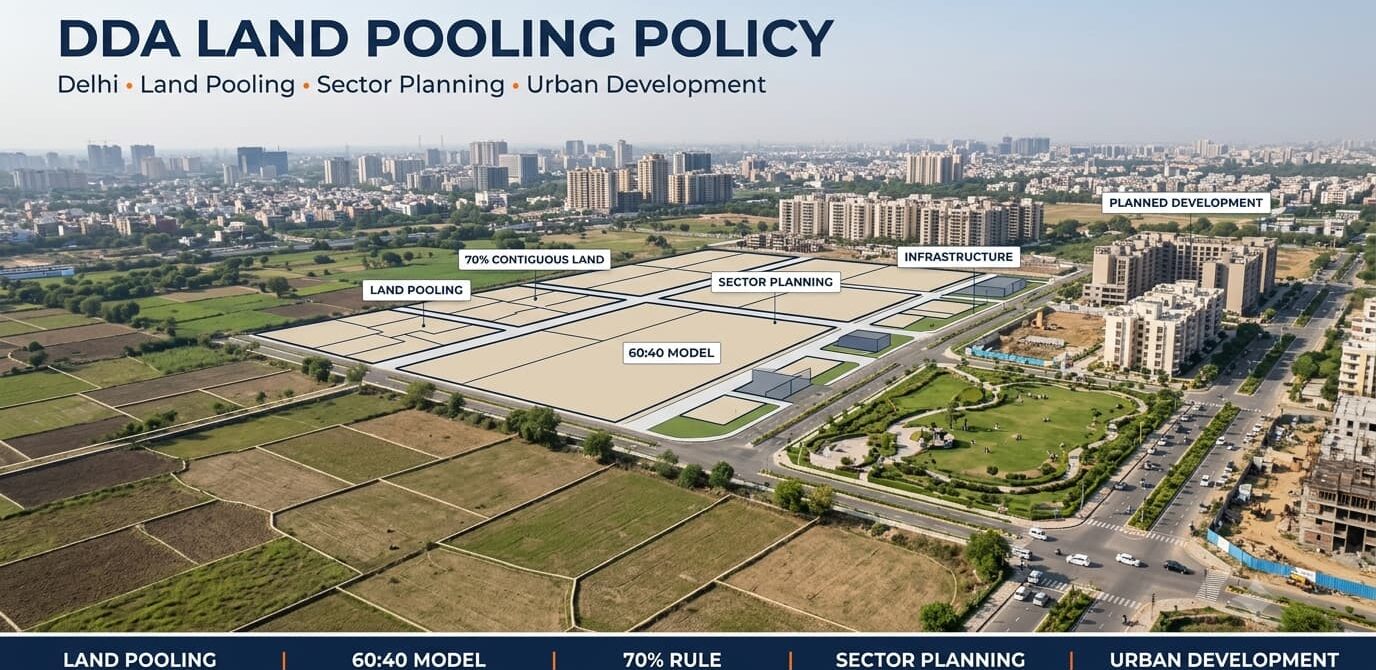
DDA Land Pooling Policy Delhi is a way in which planned urban development is achieved by integrating the participating land parcels into the sector level planning. The idea is not to let each plot grow on its own but rather create a much bigger planned area where the roads, utilities, residential and commercial development, open space and other public facilities can be made in an integrated fashion. The advantage of this policy is that it gives land owners an organized way to participate in planned development while buyers must know the exact status of the property that they are looking at.
What Is the DDA Land Pooling Policy?
DDA Land Pooling Policy is a development policy in which the participating owners participate in the process of development planning by pooling in their land. It aims to remove the drawbacks associated with fragmentary development, such as improper planning of roads, utilities, green areas, etc. in individually developed plots. As per land pooling, the participating lands are evaluated on the basis of the entire sector in which they are located. This policy was amended and notified in October 2018, with regulations regarding the implementation of this policy. The present policy includes designated villages in six planning zones and several sectors.
This means land pooling is not simply a process of combining ownership records. It connects land participation with a broader development framework covering infrastructure, land distribution and planned urban uses.
How Does DDA Land Pooling Work?
The DDA land pooling process includes various phases before the sector moves towards its development. The first phase entails participation of landowners in the process and submission of relevant data regarding ownership and parcels. The participating lands are then plotted and reconciled in the relevant planning zone. The sector is further evaluated on the basis of pooling conditions, which include provision of sufficient contiguous pooled lands. On fulfillment of the required conditions, the participating landowners may use the consortia mechanism followed by planning at sector level. Roads, utilities and other infrastructure should also be taken into consideration as part of the larger planning process.
Broad DDA Land Pooling Process
- Landowner participation and submission of relevant property details
- Ownership and document verification for participating parcels
- Parcel mapping and reconciliation within the applicable sector
- Sector assessment against prescribed pooling conditions
- Achievement of the required contiguous pooled-land threshold
- Consortium formation among participating landowners, where applicable
- Sector-level planning and land distribution
- Development arrangements and applicable approvals
- Infrastructure development and planned urban development
The exact progress and requirements can vary according to the relevant sector and applicable planning framework, so landowners should establish the status of their specific parcel rather than relying on general information about the surrounding area.
DDA Land Pooling Policy 60:40 Model
The DDA land pooling 60:40 concept is probably one of the most crucial concepts for the land owners to know. Generally, the concept of 60% can be termed as the development side ratio, which pertains to the land owners or their group, while 40% relates to the DDA and its infrastructure requirements for planned development. But this is not to be taken in a way that the owner gets 60% of his/her own land in the exact size and shape he/she had before. Sector level planning requires land for various infrastructures like roads, utility etc.
| Component | Broad Purpose |
| 60% | Development-side share associated with participating landowners/consortium |
| 40% | Infrastructure, public requirements and planned development |
| Sector planning | Determines the practical arrangement and distribution |
| Infrastructure requirements | Includes roads, utilities, open spaces and public facilities |
Therefore, landowners should evaluate the 60:40 model as part of the complete sector development framework rather than treating it as a simple percentage calculation on an individual plot.
What Is the DDA 70% Rule?
DDA land pooling 70% requirement involves the requirement for obtaining the necessary level of contiguous pooled land in a sector for the sector to move forward towards development as per the appropriate framework. This is very important to note because the 70% requirement is related to the size and continuity of the pooled land and not the number of participating land owners. Contiguous lands provide a base for planning roads, utilities, public facilities, green areas and development plots, while a fragmented participation will pose a challenge in coordinating the infrastructure.
Sector 8B in Zone P-II is very important in the context of the framework after satisfying the threshold of 70% contiguous pooled land and moving towards development. However, it should not be misunderstood that all properties in the sector become development ready simply because the threshold has been achieved.
DDA Land Pooling Policy Zones and Sectors
The current DDA land pooling zones are divided into six major planning zones. Current planning information refers to 105 villages and 138 sectors within the framework. These zones and sectors provide the broader planning structure through which participating land is assessed and development is organized.
| Planning Zone | Land Pooling Role |
| K-I | Designated land pooling planning zone |
| L | Designated land pooling planning zone |
| N | Designated land pooling planning zone |
| P-II | Designated land pooling planning zone |
| P-I | Designated land pooling planning zone |
| J | Designated land pooling planning zone |
For a property buyer, however, knowing only the planning zone is not sufficient. The exact village, Khasra or parcel, sector and pooling status should be established before evaluating the property. Properties located within the same village may have different planning positions, ownership situations or pooling status.
Land Use Under the DDA Land Pooling Framework
One of the main goals of land pooling is to develop structured land use plans along with the process of infrastructural development. Based on the particular sectoral plan and the development control rules that exist, the particular area planned for can provide residential and commercial developments along with other infrastructural aspects such as roads, utility services, parks, greenspace, institutions for education and health care, and many others.
Potential planned uses and infrastructure can include:
- Residential development
- Commercial areas
- Roads and transportation infrastructure
- Parks and green spaces
- Schools and educational facilities
- Healthcare and community facilities
- Water, sewerage and drainage infrastructure
- Other public and social infrastructure
Most importantly, inclusion within a land pooling area does not automatically make an individual parcel development-ready. Buyers should verify the applicable land use and development conditions for the exact property.
What Is a Consortium in DDA Land Pooling?
The consortium offers a collectivity approach where participating landowners are able to co-ordinate their participation in sector-based development. Given that land pooling requires many landowners and large development areas, the co-ordination may assist in solving the issues of land contribution, planning, distribution, and development. The consortium could also offer an approach to facilitate the co-ordination of participating landowners and the relevant authority in the course of development. It would be essential for the landowners to be aware of the consortium status of their property. Prior to any claims in relation to the consortium, the participating land and ownership documents should be verified.
DDA Land Pooling Policy for Landowners
For the land owner, the foremost consideration is to identify the precise planning and ownership position of the land. It is not correct to take a view on an individual piece of land simply because the village or surroundings of the land are under the DDA land pooling scheme. The piece of land must relate to the particular planning zone/sector/and land pooling.
Landowners should pay particular attention to:
- Ownership and title records
- Khasra and parcel details
- Planning zone and sector
- Participation in the pooling framework
- Consortium-related requirements
- Applicable land use
- Development conditions and restrictions
Maintaining accurate documentation can reduce confusion when the land moves through different stages of planning and development.
DDA Land Pooling Policy for Buyers
For buyers, the phrase DDA pooled land should never be treated as automatic proof that a property is approved, immediately developable or guaranteed to appreciate. A buyer needs to establish the exact status of the property and distinguish between existing infrastructure and future development proposals.
| Buyer Verification | What to Establish |
| Ownership/title | Whether the seller has valid ownership |
| Khasra/parcel | Exact identity of the property |
| Zone and sector | Applicable planning framework |
| Pooled/unpooled status | Position within the land pooling process |
| Participation | Whether the relevant landowner has participated |
| Consortium | Applicable collective arrangement |
| Land use | Permitted or planned use |
| Road access | Actual physical connectivity |
| Infrastructure | Existing versus proposed facilities |
| Permissions | Applicable approvals and restrictions |
This verification becomes particularly important where property advertisements make claims about future roads, residential development, commercial use or expected appreciation.
Opportunities and Risks
The DDA land pooling framework can support more organized urban expansion by connecting land aggregation with infrastructure and sector-level planning. Coordinated roads, utilities, public facilities, residential areas and commercial development can create a more structured development environment than fragmented construction. However, the benefits depend on implementation, sector conditions and applicable planning requirements.
Potential Opportunities
- Organized residential and commercial development
- Planned road and utility networks
- Public and social infrastructure
- Better coordination of open and green spaces
- Sector-level urban development
Important Risks
- Ownership or title issues
- Confusion between pooled and unpooled land
- Development delays
- Changes in planning requirements
- Uncertainty around infrastructure timelines
- Misleading claims about approvals or future appreciation
Property appreciation should therefore never be considered guaranteed simply because a property is located within a land pooling area.
Current Status of DDA Land Pooling Policy
The policy has been developed with the help of sector level mapping, participation, consortium activities and land allocation in the selected regions. Nonetheless, the complete land pool policy should not be viewed as complete. Development depends on the condition of sectors, involvement of landowners, planning needs, infrastructure and relevant permissions. As for property owners and purchasers, property level verification is crucial. The status of development of one sector or property cannot be applied to the other simply due to the fact that both belong to the same village or planning area.
FAQs
What is DDA Land Pooling Policy?
It is a framework for aggregating participating land parcels at the sector level to support coordinated residential, commercial, infrastructure and public development.
What is the DDA 60:40 model?
Broadly, 60% represents the development-side share associated with participating landowners or consortiums, while 40% is associated with DDA-related infrastructure and planned public requirements.
What is the DDA 70% rule?
It refers to the prescribed level of contiguous pooled land required within a sector for progression toward development under the applicable framework.
Which zones are covered by DDA land pooling?
The six major zones are K-I, L, N, P-II, P-I and J.
Is every property in a land pooling village automatically pooled?
No. The exact parcel, Khasra, sector, participation and pooled or unpooled status must be verified.
Can buyers purchase DDA pooled land?
Transactions may be possible subject to applicable ownership, planning, land-use and legal requirements. Buyers should verify the exact property status before proceeding.
What should buyers verify before purchasing pooled land?
Buyers should verify ownership, Khasra details, zone, sector, pooling status, consortium position, land use, road access, infrastructure and applicable permissions or restrictions.
Conclusion
DDA Land Pooling Policy Delhi is a policy that gives an overall idea for coordinated urban growth by bringing together the land parcels involved in the process with the development of sectors. In this context, the 60:40 formula, 70% land requirement in continuity, consortium formation and sector planning play significant roles within this policy. For the land owners, knowledge about the involvement, documentation and sector requirements become vital. For the buyers, the main thing that must be done is to identify the property precisely rather than making generalizations on a particular village or zone or future development. Things like property ownership, Khasra number details, pooling, land usage, consortium position, infrastructure and development conditions should be checked before deciding on a property. Sapient Realty gives the real estate related information to property hunters about planning and market changes.
Address Open On Google Map
- Address: Delhi
- Zip/Postal Code: 122001
Amenities
- 100% Power Back Up
- 24 Hour Water Supply
- 3 Tier Security
- Air conditioning
- Balcony
- Car Paking
- Club House
- Gymnasium
- Internet
- Kids Play Area
- Lift
- Sports Facility
- Swimming Pool
- Wi-Fi







There are no reviews yet.