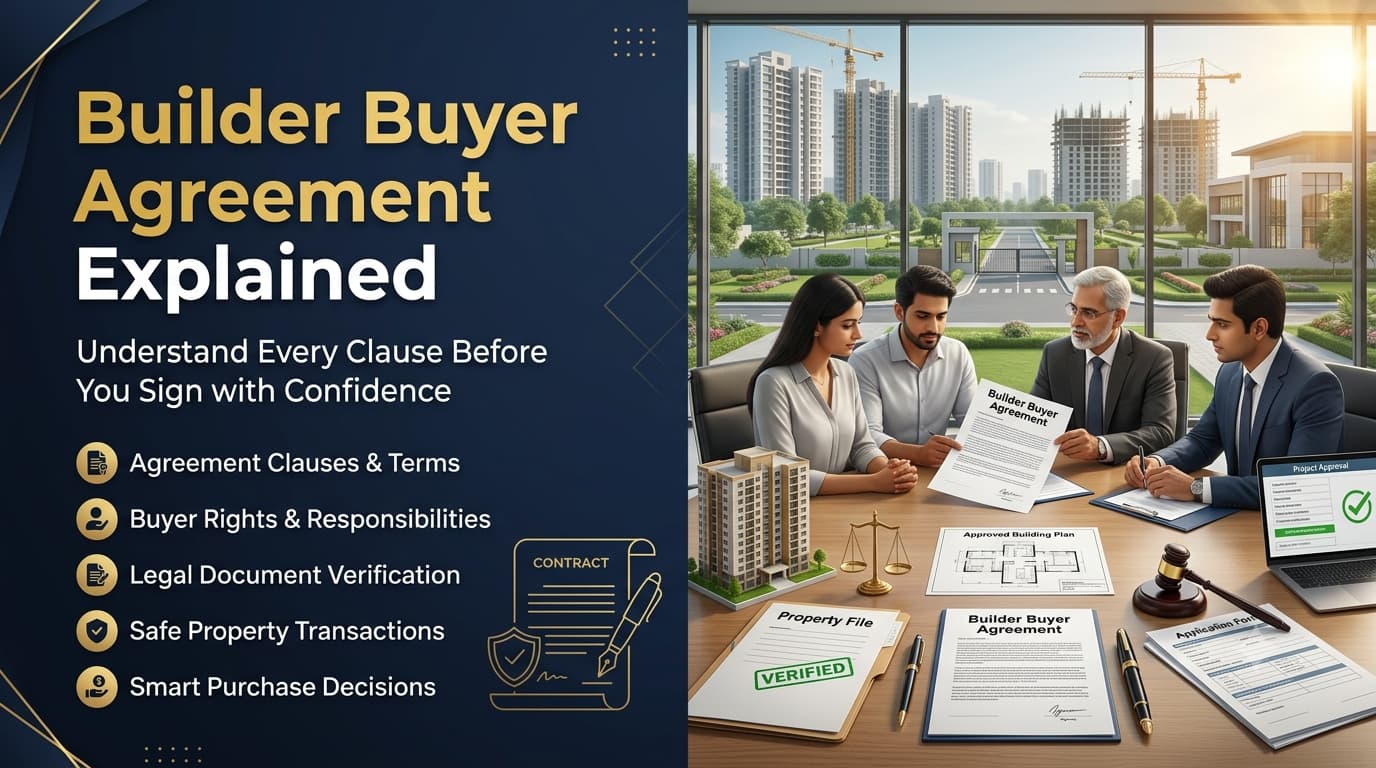
Builder Buyer Agreement Explained
The signature of the Builder Buyer Agreement is the most significant step in all purchase process since it lays out what both parties have agreed upon. Despite the attractive brochures, verbal agreements, and other marketing tools, only the agreement itself will hold legal weight if there is any disagreement later on. Many individuals get overly excited about their purchase and pay little attention to the details which can cause misunderstanding, unexpected liabilities, or long legal disputes at a later date. Careful reading of all clauses, knowledge of what duties each side undertakes, and verification of additional documents prior to signing will help make an informed decision.
The agreement drafted properly guarantees clear understanding of time frames, payment terms, construction terms, possession terms, cancellation clauses, and remedies in case one of the parties fails to honor its obligations. Instead of regarding the agreement as some routine step, it needs to be seen as a legal tool that will protect your interests during the whole process of purchasing. This guide covers all aspects of the Builder Buyer Agreement in plain language to help you understand your rights and possible risks and avoid mistakes that many first-time buyers commit unknowingly.
What Is a Builder Buyer Agreement
This Agreement is a legally binding contract made between the developer and the buyer of the property. This is a legal document that serves as the basis for the transaction by defining what has been agreed to between the two parties involved. It is not based on any kind of verbal agreements but rather it specifies all that has been mutually agreed to in the form of a written legal document. Such an agreement usually contains several clauses like those related to the unit purchased, payments, construction and delivery dates, specifications, etc.
Every word used in the agreement becomes an important one because it dictates what both parties will be able to demand of each other once the agreement has been signed. Though the entire procedure seems to be quite simple, failing to pay attention to even one clause may become problematic later on, in case of delays, changes in the design, and differences in possession. It is also useful to have a well-written agreement so that everything becomes clear from the very start, and the chances of misunderstandings become less likely. It is important to know about all the provisions before signing the agreement, as it is important as choosing the right project.
Why This Agreement Matters Before Signing Any Document
Often, many people believe that once a proper project is chosen, there is nothing much left in terms of paperwork, but this misconception may cost them dearly when some crucial points are missed. This Agreement decides the course of action that shall be followed by both the parties – the developer and the buyer – from the day the contract is signed till the possession date and beyond. This is the agreement that defines all the details regarding payments, building, possession dates, penalties, and compensation in case of non-fulfilment of the contract.
It would also be prudent to examine the agreement alongside other documentation to confirm consistency in the commitment throughout the whole process. For instance, verification that statutory clearances are available and absence of any latent legal claims can be greatly simplified by referring to the Encumbrance Certificate Guide as well, since it proves that there are no particular legal obligations attached to the property in question. Moreover, permission from the concerned authority/society may be necessary under certain circumstances, which makes the Property NOC Guide another useful guide in this context. Examination of every document together would make your legal standing much more secure and minimize the risk of any avoidable conflicts later on.
Rights and Responsibilities of Both Parties
The Builder Buyer Agreement is a tool that ensures the protection of both the developer and the purchaser through a clear definition of the obligations each has to undertake. Usually, the developer will be tasked with undertaking the project based on the agreed plans, quality standards, and getting all the approvals, as well as delivery of possession of the same. In the same way, the buyer has to meet his or her obligations as per the defined schedule and terms of payment of the purchase price.
Documents You Should Verify Before Signing
Only reading the Buyer Agreement alone is insufficient because supporting documentation is just as essential in validating the legitimacy of the deal. In addition, buyers must confirm approved plans, documents about the title, statutory approval, identities of the parties involved, and declarations which are part of the agreement. Checking these documents will help to ensure that all the information in the agreement are correct and consistent with each other. Any discrepancy in information from the agreement and supporting documents must be immediately addressed before going forward with the process.
Another document which buyers need to look into is another set of documents which further strengthen due diligence. These include the Encumbrance Certificate Guide that explains how to validate the existence of encumbrances in relation to the property, and the Property NOC Guide which discusses scenarios wherein one needs to have a No Objection Certificate for some specific transactions.
Common Mistakes Buyers Make While Signing the Agreement
Unfortunately, many consumers get so involved in the transaction process that they end up signing This Agreement without examining all of its sections thoroughly. Using verbal promises, neglecting essential timelines, neglecting penalty clauses, or even not confirming accompanying documents are some of the most frequent errors made by buyers. Moreover, buyers think that all agreements have a similar format while terms and conditions can differ greatly between different projects. Spending enough time reviewing the document and consulting professionals in case of necessity can help to avoid potential legal troubles in the future.
Another error is forgetting to keep a copy of each document signed and all correspondences. Buyers need to save receipts, emails, approved plans, and other written promises received during the process. These documents will be very helpful in case of any dispute in the future. Making everything correctly from the very beginning is important both for protecting your legal rights and simplifying the entire process of being an owner.
Difference Between Builder Buyer Agreement and Conveyance Deed
While these documents are related to each other, they have entirely different legal purposes and must never be confused with one another. A Buyer Agreement documents the terms and conditions between the builder and the purchaser before the transfer of ownership. It describes the roles of both the parties, payment terms, construction terms, possession terms, and other such obligations of a contract that rule the transaction. However, a Conveyance Deed is a legal document that actually makes the transfer of ownership possible from the seller to the purchaser after fulfilling all the necessary conditions.
This differentiation allows the purchasers to understand what document safeguards their contractual interests and what document establishes legal ownership for them. Getting these two documents confused can result in unnecessary misunderstandings; particularly, for first-time purchasers. For further clarification about the process of transferring the ownership after the agreement process, see Conveyance Deed Explained.
What Happens if the Original Buyer Passes Away
At times, unexpected scenarios might occur prior to full transfer of ownership of property. In such cases, it is crucial that family members know what the process entails legally. In cases where the initial purchaser dies, the process of transfer of rights will normally depend on the laws of succession, whether there is a valid Will and the necessary legal documents as per the concerned authorities. Although procedures may be varied depending on different circumstances, proper documentation can eliminate the possibility of delay and disputes among legal heirs.
Proper preparation of legal documents at all times makes the process easier for family members especially during such tough times. Knowing the difference between a Will and a Succession Certificate as well as when these documents are necessary can eliminate legal problems. For more details about inheritance documents and processes, please refer to the Will & Succession Certificate Guide.
Conclusion
The Builder Agreement is not just an ordinary document since it sets the legal relationship between the developer and the buyer at the onset of the deal until its success. Careful perusal of all clauses, checking out supporting documents, being familiar with your rights and obligations, and keeping detailed documentation will definitely decrease the possibilities of having problems later on. Just as important is to be aware of the interrelationship of the said agreement with other documents like Conveyance Deed, Occupancy Certificate, Encumbrance Certificate, Property NOC, Power of Attorney, and other related documents.
Frequently Asked Questions
What is a Builder Buyer Agreement and why is it important?
The Agreement is a legal contract that defines the rights, responsibilities, payment terms, possession conditions, and obligations of both the developer and the buyer. It serves as the primary document governing the transaction.
Is it safe to sign a Builder Buyer Agreement without legal advice?
While it is not mandatory, seeking legal advice is advisable if any clause is unclear or appears unfair. Professional review can help identify potential risks before signing.
What documents should I verify before signing a Builder Buyer Agreement?
You should verify title documents, approved plans, statutory approvals, identity documents, payment terms, and other supporting records to ensure all information is accurate and legally valid.
Can the terms of a Builder Buyer Agreement be negotiated?
Certain clauses may be negotiable depending on the developer’s policies and the stage of the transaction. Buyers should discuss any concerns before signing the agreement.
What happens if the developer delays possession?
The agreement generally contains clauses explaining the rights of both parties, including any remedies or compensation available for delays, subject to the agreed terms.
Is a Builder Buyer Agreement the same as a Conveyance Deed?
No. The Agreement defines the contractual relationship, whereas the Conveyance Deed legally transfers ownership after all required conditions have been fulfilled.
Can someone else sign the Builder Agreement for me?
Yes, in certain situations, an authorised representative may sign on your behalf through a legally valid Power of Attorney, subject to applicable legal requirements.
Should I check the Occupancy Certificate before taking possession?
Yes. Verifying the Occupancy Certificate Guide helps confirm that the completed building has received the required approval for occupation.
Why should I verify an Encumbrance Certificate before purchasing?
An Encumbrance Certificate helps confirm whether the property has existing legal claims or financial liabilities that could affect ownership.
What happens to the agreement if the buyer passes away before ownership transfer?
The legal process generally depends on succession laws, the existence of a valid Will, and the documents required for transferring the buyer’s rights to the legal heirs.