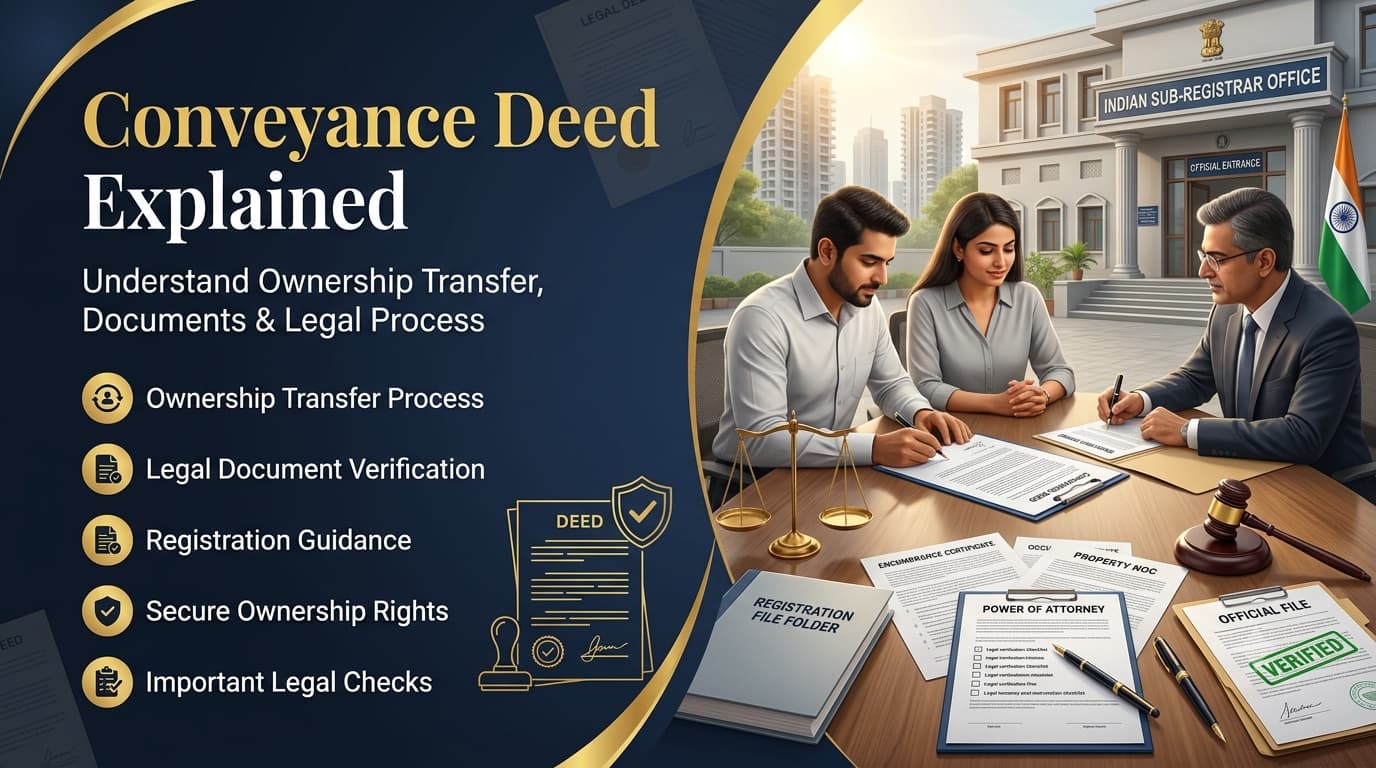
Conveyance Deed Explained
Understanding legal documentation is essential to make the right choices and ensure that all your needs are met in the long run. People often carry out large-scale transactions without comprehending their legal documents completely, and they usually face difficulties when the question of proof arises during any situation regarding ownership rights. Proper knowledge of such legal documents ensures smooth sailing without having to face problems in the future. It will help in avoiding complications and ensure that all the steps are completed with proper knowledge.
The Guide on this will help you in comprehending the most significant legal document used to transfer ownership rights to another individual. Although many agreements and negotiations help in laying down all the terms between the two parties, this document is important to legalize the transfer once all the necessary conditions have been met. Knowing about its importance and relation to other legal documents will help you deal with ownership matters effectively. This guide covers all the aspects related to the Conveyance Deed.
What Is a Conveyance Deed
This Certificate is a legal instrument through which ownership rights of an asset are formally transferred from one owner to another party. It serves as written evidence that the transfer of ownership rights takes place in accordance with the agreed terms and legal requirements. The document includes important information, such as details about the parties involved, asset description, terms of transfer, rights to transfer, and other important declarations. After proper execution and registration, this document becomes a very important document to prove the legal rights of the new owner.
As compared to preliminary agreements that only establish future intentions of the parties, a This Certificate is a step of finalization of the ownership transfer process. It legally acknowledges the transfer of ownership and ensures maintenance of good ownership record for future purposes. Considering its importance in the long term, all the details stated in the deed need to be double-checked before the finalization of the document.
Why it Is Important
It is imperative to note that the This Certificate offers proof of the transfer of ownership rights from one individual or organization to the other. In cases where there is no proof of ownership, it becomes difficult for one to prove their ownership rights to any third-party, especially when it comes to transactions, inheritance, and even official purposes. Such document establishes a link between the previous owner and the current one, hence making it possible to have a record of ownership.
It is important to mention that the This Certificate makes it easier to protect the interests of the person who will receive the ownership rights. One must ensure that all the necessary documents are in place and that there is no issue with the claim against the transfer at all. By reviewing the relevant documents, such as those stated in Encumbrance Certificate Guide, it would be easier to identify any issues of claim or encumbrance associated with the ownership. The same can apply to the Property NOC Guide, where it helps to understand the situations that might require an approval before the process of transfer takes place.
Difference Between Conveyance Deed and Other Legal Documents
A Conveyance Deed can be confused with many other legal documents since there are many documents that need to be used during various phases of an ownership transfer process. But these documents play different roles and have distinct purposes. For instance, the agreement made between the two parties reflects the intentions and conditions prior to the actual transfer of ownership. On the other hand, a The Certificate is the one that reflects the transfer of ownership once all the necessary steps have been completed. It will help people to know which document grants them ownership and which one only makes a contract.
Details That Are Crucial for a Conveyance Deed
When a conveyance deed is prepared in the right way, it should include many crucial details that ensure clarity and safeguard the interest of both the parties. In general, these details include the person who is transferring the ownership, the person who receives the ownership, identification information, the property description, transfer details, the rights that are being transferred and declaration regarding ownership. All the details should be correct according to the available records since the smallest mistake can cause problems in future transactions.
Documents Required for Preparing The Certificate
There are many documents which act as a support in preparing a Conveyance Deed. There could be variations in terms of the number of documents depending on the procedure that is being followed but having all the records in order is imperative. Identity documents, ownership documents, approved documents, and transaction documents are some of the documents which can be checked in order to ensure that the record is right. If there are any discrepancies in the documents then there would be some delays involved and other issues at the time of registration.
Apart from getting the documents in order there is the need to verify the supporting record pertaining to the asset. It is helpful to refer to the guide for Encumbrance Certificate in order to identify if there are any claims which can be cleared beforehand. It is also necessary to see the guide for Property NOC as this guide helps one identify when permissions would be required. This ensures that the transfer process is being done with verification.
Step-by-Step Process of Executing a the Deed
The process of completing the The Certificate includes several steps that have to be undertaken by those involved with a high level of accuracy so as to make the transfer of ownership valid. The initial step is normally writing the deed with all the correct data concerning both the parties and the asset whose ownership will be transferred. When everything has been checked and found to be accurate with all the necessary papers in place, then the two parties sign the document according to the relevant laws.
After the deed has been signed, it is registered with the relevant authority. This gives it the legal recognition it needs and creates an official record for it. It is wise to store the registered deed together with other documents concerning ownership in a safe place.
Common Mistakes to Avoid During the Transfer
A lot of people tend to believe that the preparation and execution of Conveyance Deed are merely procedural matters, but lack of attention to detail may cause serious problems in the future. For example, it may happen that one neglects to check ownership documents prior to transferring ownership. The other mistake that one may make is neglecting to confirm if the information included in the deed corresponds to the documents. Mistakes in names, descriptions, boundaries, and even in information about ownership may become an obstacle in subsequent deals and will have to be corrected through some extra legal procedures.
One more typical error is the neglect of incomplete documents, unresolved claims or pending approvals prior to transferring ownership. One should not be too hasty in the process and take time to carefully consider each document necessary for the transaction. One should keep in mind how the ownership transferred in the Deed is linked with other legal aspects in case the asset becomes subject to further transactions.
After Inheritance or Succession
However, ownership is not necessarily transferred in a transaction between two persons. In some circumstances, the ownership rights could go to the legal heirs of the original owner after his/her lifetime. In such circumstances, it would become necessary for one to comprehend succession documents and also follow the legal procedures for the successful transfer of ownership. The valid Will, succession documents, and other supporting documents could become crucial to the establishment of legal heir rights.
Once succession rights have been established, other documentation could become necessary to facilitate the updating of the ownership details. The comprehension of the relationship between the documents of inheritance and ownership transfer will prevent confusion during this process. The Will & Succession Certificate Guide gives all information relating to inheritance planning, legal heir rights, and the documents required for ownership through succession.
Frequently Asked Questions
What is a Conveyance Deed and why is it important?
The Certificate is a legal document that officially transfers ownership rights from one person to another. It is important because it provides formal proof of ownership transfer and creates a clear legal record.
Is a Conveyance Deed the same as a sale agreement?
No, both documents serve different purposes. A sale agreement generally records the terms and conditions between parties before completion, while a Conveyance Deed completes the legal transfer of ownership.
What details are mentioned in a Conveyance Deed?
The Certificate generally includes details of the parties involved, asset description, ownership transfer terms, rights being transferred, declarations, and other important legal information.
Is registration of a Conveyance Deed necessary?
Registration requirements depend on applicable laws and the nature of the transfer. In many cases, registration provides official recognition and creates a permanent record of ownership transfer.
What documents are required for preparing a Conveyance Deed?
Required documents may include identity proofs, ownership records, previous documents, approvals, and other transaction-related records. The exact requirements depend on the specific circumstances.
Can a Power of Attorney holder execute a Conveyance Deed?
A person authorised through a valid Power of Attorney for Property may execute certain actions on behalf of the owner if the authority granted specifically allows it and complies with applicable legal requirements.
How does a Conveyance Deed help in proving ownership?
A registered Conveyance Deed acts as legal evidence of ownership transfer and helps establish a clear ownership record for future verification or transactions.
Why should I check an Encumbrance Certificate before a Conveyance Deed?
Checking an Encumbrance Certificate helps identify possible existing claims, liabilities, or legal issues that may affect the ownership transfer process.
Is a Conveyance Deed required after inheritance?
The requirement depends on the circumstances and legal process involved. When ownership passes through succession, additional documentation may be required before completing further transfers.
What should I verify before signing a Conveyance Deed?
You should verify ownership details, supporting documents, approvals, legal status, party information, and any existing claims before signing the document.
Conclusion
The Deed is a significant legal instrument that serves to record the transfer of ownership rights and clarify ownership in the long run. Knowing the purpose of the deed, necessary documents, verification procedure, and the relationship between the Certificate and other legal documents enables an individual to carry out the transaction with more certainty. Well-drafted this Deed guarantees the interests of all parties and lays down the ground of ownership for future use. In case you need to learn more about legal documentation and ownership issues, you may refer to the comprehensive guides available at Sapient Realty.