
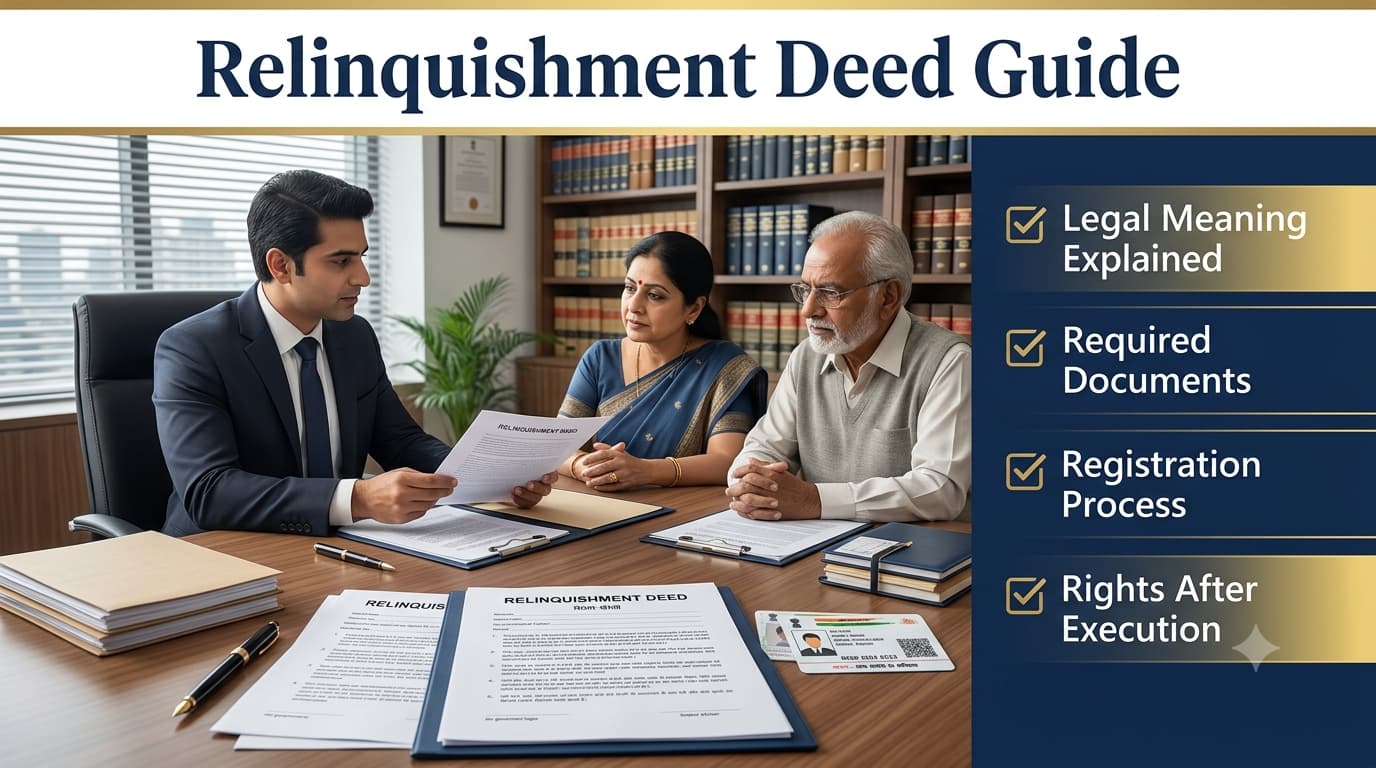
Purpose of Relinquishment Deed
Legal documents are always very significant for avoiding possible misunderstanding among family members. In case several people have lawful claims on inheritance, a Legal Document is always very helpful for solving such issues. A Relinquishment Deed is one example of a document where a person may voluntarily forego his legal right in favour of some other family member who is eligible. Being a matter of legal rights, it is important that such a document is prepared very carefully and is executed in accordance with the required legal procedure. Knowing what for it is used will definitely help people to avoid making wrong decisions and thus help to avoid further conflicts.
Why This Document Should Be Understood
A properly prepared Relinquishment Deed serves as evidence of the intention of one of the legal heirs to renounce his rights in relation to certain property received as inheritance. Such a document can help to avoid further legal complications and confusion. Also, being aware of the legal implication of the deed and how it should be done, all family members can participate in this process in a transparent way. This guide has been prepared to explain these aspects in a practical and reader-friendly manner so that individuals can better understand the overall process before consulting a qualified legal professional.
Quick Guide Snapshot
| Point | Details |
| Document Name | Relinquishment Deed |
| Purpose | Voluntary release of legal share by one legal heir in favour of another eligible legal heir |
| Commonly Used For | Family inheritance settlements |
| Applicable Between | Legal heirs having lawful rights in inherited assets |
| Registration | Generally required under applicable registration laws |
| Witness Requirement | Normally executed in the presence of witnesses |
| Legal Effect | Transfer of relinquished rights to the beneficiary |
| Revocability | Generally irrevocable after valid execution and registration, subject to applicable law |
| Best Practice | Execute with legal guidance and complete documentation |
Key Features of a Relinquishment Deed
Relinquishment Deed is a voluntary legal document under which a legal heir relinquishes his legal share for the benefit of another legal heir. This document is usually drafted when the family members agree mutually to distribute the inherited property and make it legally binding. After proper drafting and registration, it usually acts as valid proof of the transfer of rights. Every legal document should always reflect the free will of all the parties concerned and should have comprehensive information to avoid any future legal complications.
When Is Relinquishment Deed Used?
Relinquishment Deed is usually prepared when one or more legal heirs do not want to hold their share in inherited assets and want to transfer their rights to another legal heir. It is usually done when a family member dies and creates succession by giving rise to more than one legal heir.It may also be used when one heir wishes to avoid future responsibilities related to jointly inherited assets. Since every family situation is different, obtaining legal advice before execution is always recommended.
Eligibility Criteria
| Eligibility Requirement | Details |
| Legal Relationship | Parties should generally be legal heirs to the inherited assets. |
| Voluntary Consent | The decision must be made willingly without force, fraud, or undue influence. |
| Legal Capacity | Every executing party should be legally competent to enter into an agreement. |
| Identifiable Rights | The legal share being relinquished should be clearly identifiable. |
| Mutual Understanding | All parties should clearly understand the legal consequences before signing. |
Required Documents
| Document | Purpose |
| Identity Proof | Establishes the identity of each executing party. |
| Address Proof | Confirms the residential address of the parties. |
| Death Certificate of the Deceased | Establishes succession in inheritance matters. |
| Legal Heir Certificate or Equivalent Proof | Demonstrates the relationship of the legal heirs where applicable. |
| Previous Ownership Documents | Helps establish the chain of lawful ownership. |
| Passport-size Photographs | Used during documentation and registration formalities. |
| PAN Card or Applicable Tax Identification | Required wherever applicable under law. |
| Any Additional Supporting Documents | May be requested depending on local legal requirements. |
Registration Checklist
| Checklist Item | Status Before Registration |
| Verify identity documents | ✔ |
| Confirm legal heir details | ✔ |
| Review the deed for accuracy | ✔ |
| Ensure voluntary consent of all parties | ✔ |
| Arrange witness identification | ✔ |
| Carry original supporting documents | ✔ |
| Verify signatures before submission | ✔ |
| Complete registration formalities with the appropriate authority | ✔ |
Registration Process
Normally, the process starts by making out the Relinquishment Deed which includes correct personal information, the description of the rights being relinquished, and the consent of all parties involved. Before executing the deed, all clauses should be thoroughly examined to make sure that there are no mistakes. Afterward, the deed should be executed by the interested parties in front of witnesses and be brought to the relevant registration authority together with the necessary documentation. After examining the identification of the parties and their documentation, the authorities will register the deed according to the prescribed formalities of the existing legislation.
Legal Rights After Registration
Once the legal process of registering the Relinquishment Deed has been successfully completed, the person who is giving up his legal right will usually not have any further rights in regards to the relinquished interest whereas the beneficiary will enjoy these rights in compliance with the deed and relevant laws. This registered deed will be used as documentary proof in any subsequent legal proceedings that might arise in connection with property ownership in the future. It ensures clarity through the official recording of the intentions of the parties concerned. As legal implications can vary from case to case, the parties must store this registered document in a safe place.
State-wise Factors Affecting Stamp Duty
| State / Region | General Factors Considered |
| Delhi | Applicable state laws, relationship between parties, nature of the transaction, and prevailing government regulations. |
| Uttar Pradesh | State legislation, registration requirements, relationship of legal heirs, and applicable legal provisions. |
| Haryana | Local stamp laws, nature of relinquished rights, and registration guidelines. |
| Maharashtra | State-specific stamp regulations, document type, and applicable legal framework. |
| Karnataka | Government rules, registration requirements, and legal classification of the document. |
| Other States | Stamp duty and registration requirements vary according to the respective state laws and government notifications. |
Relinquishment Deed vs Gift Deed
| Basis | Relinquishment Deed | Gift Deed |
| Purpose | Voluntary release of a legal heir’s inherited share | Voluntary transfer of ownership without consideration |
| Eligible Parties | Generally executed between legal heirs | Can be executed in favour of an eligible recipient as permitted by law |
| Common Usage | Family inheritance matters | Transfer of ownership during the lifetime of the donor |
| Legal Effect | Surrenders existing inherited rights | Creates ownership rights for the recipient |
| Registration | Generally required | Generally required |
| Consideration | Usually without monetary consideration | Normally without monetary consideration |
Advantages
The Relinquishment Deed, when done in the right manner, will provide legal security because the deed will record the voluntary relinquishment of the inheritable property among the legal heirs. This deed can help minimize the risk of any future disputes and is useful for family settlements and ownership record keeping. Additionally, the deed will reduce the element of uncertainty because it acknowledges the intentions of the parties concerned through a legitimate legal process.
Limitations
A Relinquishment Deed might not be appropriate in all legal scenarios since it is designed for a certain set of cases only. The deed usually concerns eligible legal heirs, and thus should meet the legal criteria that are valid in the relevant jurisdiction. Once signed and registered according to the legal requirements, the deed cannot be undone unless there is a legal way to do so. In case of inaccurate drafting or incomplete documentation as well as lack of registration, one might run into problems with the legal effectiveness of the document.
Conclusion
A Relinquishment Deed is a crucial legal document which helps eligible family members give up their inheritance rights in a transparent and legitimate manner. Knowing the function of the document, its criteria of eligibility, the required documents, registration process, and legal implications helps individuals make rational decisions and avoid possible conflicts in the future. As the legal procedure may vary according to the specific case and state laws, the help of professionals is still necessary before signing any legal document. Readers who want to find legal sources and receive information regarding the required property documentation may also refer to Sapient Realty for useful articles.
Frequently Asked Questions
What is a Relinquishment Deed?
A Relinquishment Deed is a legal document through which a legal heir voluntarily gives up their inherited rights in favour of another eligible legal heir.
Who can execute a Relinquishment Deed?
Generally, eligible legal heirs having lawful rights in inherited assets can execute a Relinquishment Deed, subject to applicable legal requirements.
Is registration of a Relinquishment Deed necessary?
In most situations, registration is generally required under the applicable registration laws to establish legal validity.
Can a Relinquishment Deed be cancelled after registration?
It is generally considered irrevocable after valid execution and registration, although exceptional legal remedies may be available depending on the circumstances and applicable law.
What documents are commonly required for a Relinquishment Deed?
Identity proof, address proof, legal heir documents, the death certificate where applicable, ownership records, photographs, and other supporting documents are commonly required.
Is a Relinquishment Deed the same as a Gift Deed?
No. A Relinquishment Deed is generally used by legal heirs to surrender inherited rights, while a Gift Deed is used for voluntarily transferring ownership under applicable legal provisions.
Are witnesses required during execution?
Yes. The document is generally executed in the presence of witnesses as required under the applicable legal procedures.
Does stamp duty vary across different states?
Yes. Stamp duty and registration requirements are governed by individual state laws and may differ from one state to another.
Can legal advice help before signing the deed?
Yes. Professional legal advice helps ensure that the document complies with applicable laws and accurately reflects the intention of all parties.
Why is a Relinquishment Deed important?
It provides legal clarity, records the voluntary transfer of inherited rights, supports transparent family settlements, and helps reduce the likelihood of future legal disputes.


