
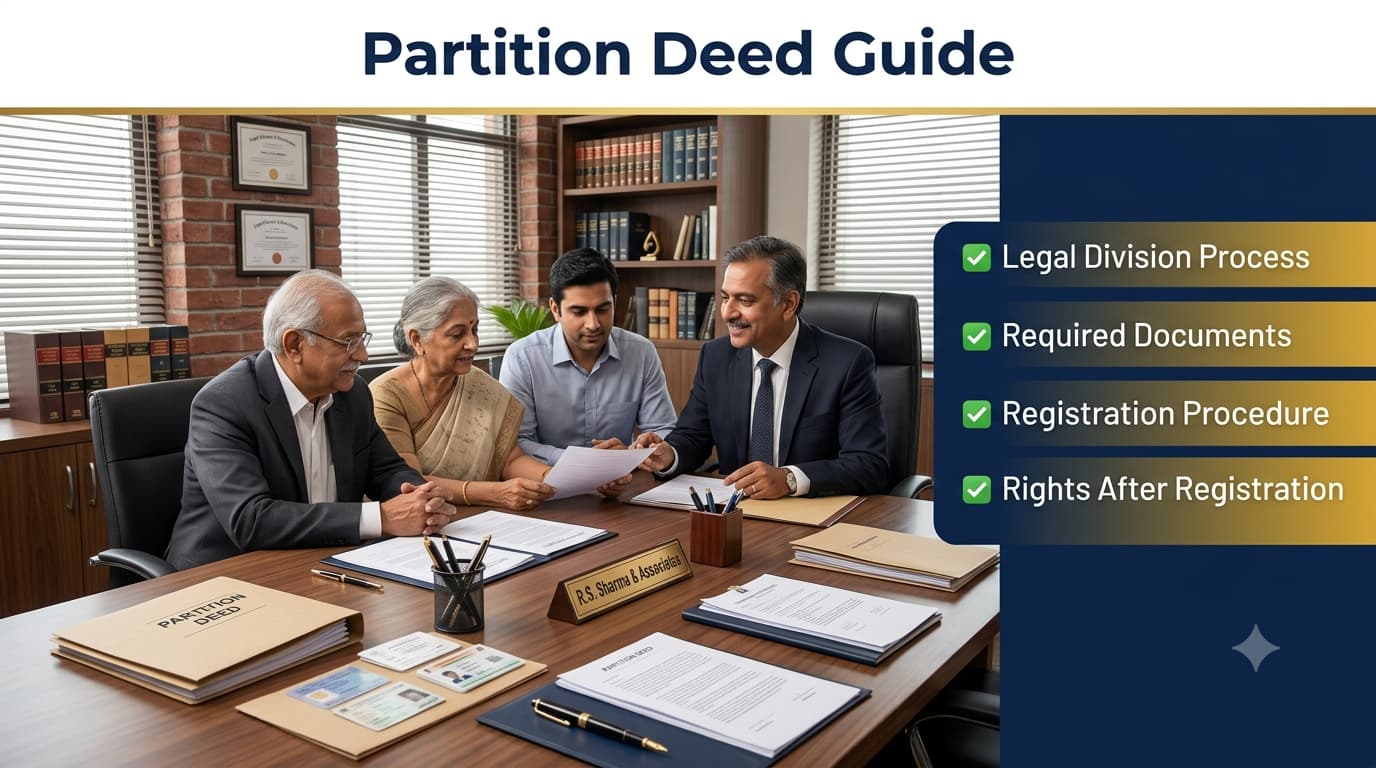
Partition Deed Guide
Family-held properties always stay joint for a long time, but eventually comes the time when all the heirs want to establish their rights separately. A Partition Deed is such a legal document which makes sure that the division of jointly owned properties or assets takes place among eligible co-owners or family members. It does not leave the ownership rights in the state of confusion and establishes the ownership of each person in respect of his/her share after the division process. The preparation of this document prevents any sort of misunderstandings in future. Having an idea about the same will surely be helpful for making right decisions in regard with the process.
Why Understanding This Document is Important?
A Partition Deed ensures the creation of legal documentation about the division process of jointly held assets. It also clarifies the ownership rights of all parties concerned after the division of joint property and avoids any type of misunderstanding in future in respect of individual shares. Since the document has lots of legal implications for all parties concerned, it is necessary for them to have knowledge about eligibility criteria, documentation and registration formalities etc. This guide explains the important aspects of a Partition Deed in a practical and reader-friendly manner to help readers understand the process before seeking professional legal advice.
Quick Guide Snapshot
| Point | Details |
| Document Name | Partition Deed |
| Purpose | Legal division of jointly held assets among eligible co-owners or legal heirs |
| Commonly Used For | Family settlements and division of jointly owned assets |
| Applicable Between | Joint owners or eligible legal heirs |
| Registration | Generally required under applicable registration laws |
| Witness Requirement | Usually executed in the presence of witnesses |
| Legal Effect | Clearly defines separate ownership rights after division |
| Revocability | Generally difficult to revoke after valid execution and registration, subject to applicable law |
| Best Practice | Execute with proper legal guidance and complete supporting documentation |
Key Features of a Partition Deed
Partition Deed is an agreement wherein the mutual distribution of jointly owned properties is stated. It shows the share of each person or entity in the property being divided and is used to change joint property into separate property wherever applicable under the law. It is drawn up with the agreement of all parties involved and is usually made in order to prevent any disputes due to confusion regarding ownership of the property in the future. If it is well prepared and is registered in accordance with the legal provisions, it gives proof of the agreed division of the property.
When Is a Partition Deed Used?
Partition Deed is usually executed whenever there is mutual decision among joint owners or legal heirs for dividing joint assets into separate property. This agreement is usually made in order to bring clarity to ownership record and to prevent any disputes in the future regarding individual ownership of the property. The deed may also be useful when every party intends to manage their respective share independently after the division. Since legal requirements can differ depending on individual circumstances, obtaining professional legal guidance before execution is advisable.
Eligibility Criteria
| Eligibility Requirement | Details |
| Joint Ownership | The parties should have a lawful joint interest in the assets proposed for division. |
| Mutual Consent | The division should be accepted voluntarily by all concerned parties. |
| Legal Capacity | Every executing party should be legally competent to enter into the agreement. |
| Clearly Identifiable Shares | The respective portions should be capable of being clearly described. |
| Compliance With Applicable Laws | The deed should satisfy the legal requirements applicable to the jurisdiction. |
Required Documents
| Document | Purpose |
| Identity Proof | Establishes the identity of every executing party. |
| Address Proof | Confirms the residential details of the parties. |
| Existing Ownership Documents | Establishes the joint ownership before division. |
| Legal Heir Documents (where applicable) | Supports the legal relationship in inheritance matters. |
| Passport-size Photographs | Required during documentation and registration formalities. |
| PAN Card or Applicable Tax Identification | Used wherever legally required. |
| Site Plan or Supporting Records (if applicable) | Helps identify the respective portions being divided. |
| Additional Supporting Documents | May be required depending on local legal provisions. |
Registration Checklist
| Checklist Item | Status Before Registration |
| Verify identity and address documents | ✔ |
| Confirm ownership records | ✔ |
| Ensure all parties have provided voluntary consent | ✔ |
| Review the deed for factual accuracy | ✔ |
| Arrange witness identification | ✔ |
| Carry original supporting documents | ✔ |
| Verify signatures of every executing party | ✔ |
| Complete registration before the appropriate authority | ✔ |
Registration Process
The process of registering starts off with the preparation of the Partition Deed where the information regarding the parties, the property which is owned jointly and the partition agreed by both of them is correctly recorded. Every detail of the document needs to be checked so that the shares of each party are correctly mentioned without any error. This document is then submitted for registration after it has been executed by all the relevant parties in the presence of witnesses. The registration authorities check the identity of the parties and the documents submitted by them and register the documents as per the procedure mentioned in the applicable law.
Legal Rights After Registration
Upon the proper implementation and registration of the Partition Deed, both parties have individual rights on the part allocated to them from the partition deed, as provided by the relevant laws. The deed registered becomes official documentation that will prove the partition and can prevent any future dispute regarding ownership of property. This is because it makes it possible for the respective parties to manage, dispose of, or handle the allocation according to the law. It is important to keep copies of the registered deed as it might come in handy in the future due to various legal considerations.
State-wise Factors Affecting Stamp Duty
| State / Region | General Factors Considered |
| Delhi | Applicable state laws, nature of the partition, relationship between parties, and prevailing government regulations. |
| Uttar Pradesh | State legislation, registration requirements, legal classification of the document, and applicable provisions. |
| Haryana | Local stamp laws, type of partition, and registration guidelines. |
| Maharashtra | State-specific stamp regulations, document classification, and applicable legal framework. |
| Karnataka | Government rules, registration formalities, and legal provisions governing the transaction. |
| Other States | Stamp duty and registration requirements vary according to the respective state laws and official government notifications. |
Partition Deed vs Family Settlement
| Basis | Partition Deed | Family Settlement |
| Purpose | Legally divides jointly held assets into separate ownership. | Resolves family disputes or distributes rights through mutual understanding. |
| Nature | Formal legal document defining individual shares. | Mutual arrangement that may later be documented formally if required. |
| Common Usage | Division of jointly owned assets among eligible parties. | Settlement of family claims and disputes. |
| Registration | Generally required under applicable laws. | Registration depends on the nature and legal effect of the document. |
| Legal Effect | Creates clearly defined ownership after partition. | Records mutual understanding and settlement between family members. |
| Documentation | Requires detailed legal documentation and supporting records. | Documentation requirements vary depending on the circumstances. |
Common Mistakes to Avoid
Legal complications occur in most cases where the Parties make a Partition Deed without conducting a thorough assessment of ownership details, relevant documents, and correct agreement about the division. All the clauses must be scrutinised to check that the name of the parties, the description of joint assets, and allocation of shares are captured in the deed correctly. Lack of the consent of all eligible parties, failure to register and using inadequate documentations can result in unnecessary disputes in the future. Keeping the copies of the registered deed and all relevant documents is necessary for future uses. Taking advice from a competent lawyer prior to executing the deed will prevent many errors and mistakes.
Advantages
The Partition Deed, when executed appropriately, gives clear legal ownership rights to each eligible party through a document. This minimises future disputes, simplifies ownership documentation, makes settlement of family affairs easy, and provides evidence of ownership of property in the future. The deed also enables each party to operate their share independently of others.
Limitations
A Partition Deed is applicable in certain legal situations pertaining to joint properties and should conform to the legal framework. The preparation of such documents normally involves the participation of all the relevant parties. After executing and registering such documents, any alteration to the partition needs to be done by legal means. Any mistakes in preparing the document or lack of necessary records or failure to follow proper legal procedures will influence the legal effect of the document. Due to differences in the legal provisions from state to state and individual situations, the assistance of a legal professional should be obtained before execution.
Conclusion
The Partition Deed becomes very significant for legally documenting the division of jointly owned assets and legally determining the ownership of individual assets. Knowledge about eligibility criteria, documentation, legal implications, and practical issues helps people to take proper actions and avoid disputes in the future. As legal procedures and documentation vary according to individual and state situations, legal assistance from the professionals should always be taken prior to execution. Readers who need legal information can consult articles at Sapient Realty for informative material regarding law and documentation.
Frequently Asked Questions
What is a Partition Deed?
A Partition Deed is a legal document used to formally divide jointly held assets and establish separate ownership rights among eligible parties.
Who can execute a Partition Deed?
Generally, joint owners or eligible legal heirs having lawful rights in the jointly held assets can execute a Partition Deed, subject to applicable laws.
Is registration of a Partition Deed necessary?
In most cases, registration is generally required under the applicable registration laws to establish legal validity.
Can a Partition Deed be modified after registration?
Changes after registration may require fresh legal documentation or other legal remedies, depending on the facts of the case and applicable law.
What documents are commonly required for a Partition Deed?
Identity proof, address proof, ownership records, legal heir documents where applicable, photographs, and other supporting documents are commonly required.
Is a Partition Deed the same as a Family Settlement?
No. A Partition Deed formally divides jointly held assets, whereas a Family Settlement is a broader mutual arrangement for resolving family rights or disputes.
Are witnesses required during execution?
Yes. The deed is generally executed in the presence of witnesses in accordance with the applicable legal procedures.
Does stamp duty differ from one state to another?
Yes. Stamp duty and registration requirements are governed by individual state laws and therefore may vary across different states.
Can legal advice help before signing the deed?
Yes. Professional legal advice helps ensure compliance with applicable laws and reduces the likelihood of documentation errors.
Why is a Partition Deed important? It provides legal certainty by clearly defining individual ownership rights, supporting transparent family settlements, and helping prevent future ownership disputes.


