
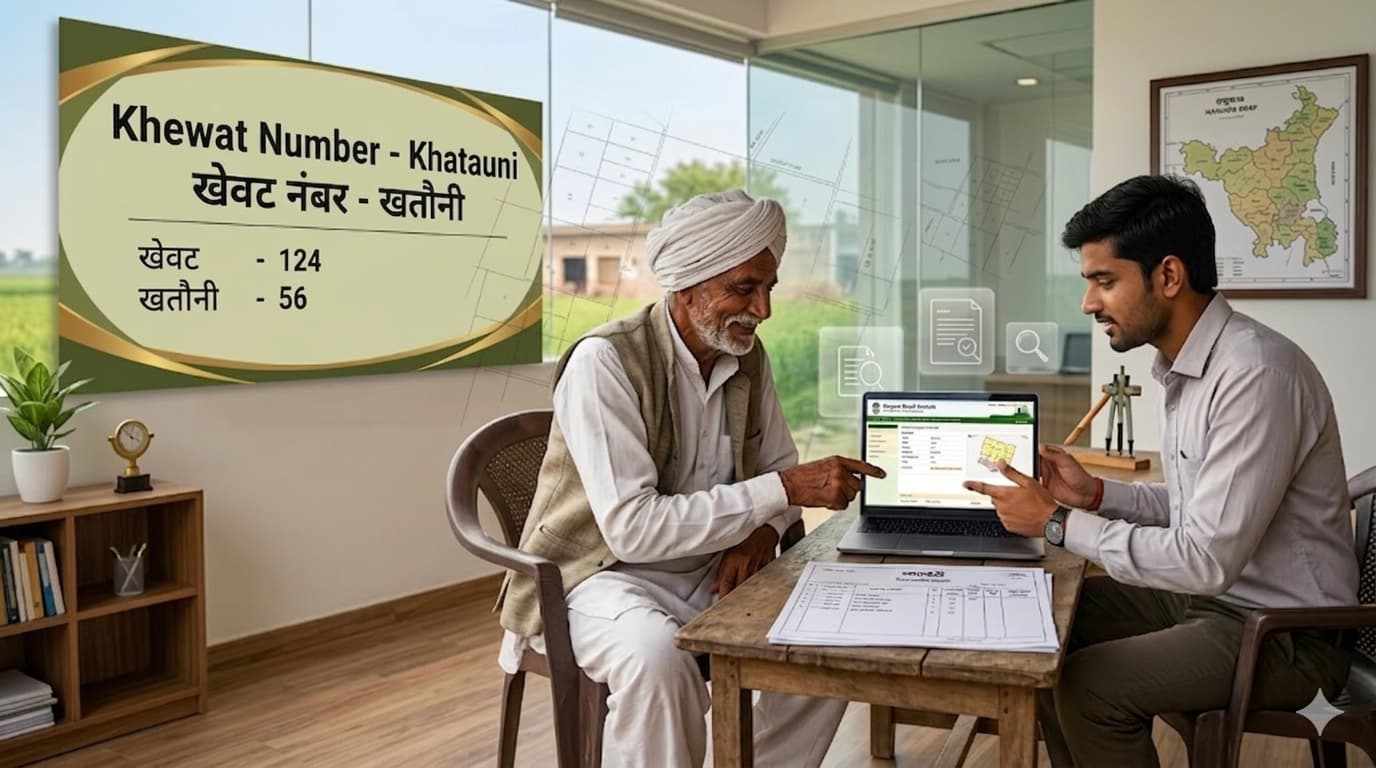
Khewat Number Khatauni
The citizens of Haryana, Punjab, and Uttar Pradesh, along with their neighboring areas such as Gurgaon 122001, Rohtak 124001, Karnal 132001, and Hisar 125001, often face difficulties while verifying their land records through the internet. This generally happens because of the use of Khewat, Khatauni, and Khasra in the same sentence on government websites. Citizens do not understand the meaning of these documents or the connection between them and thus require guidance for their proper verification. Hence, the searches for khewat number Haryana have increased exponentially in the last few years. People verifying their family history, farmers entering revenue details, and citizens cross-checking their official documents will benefit from easy-to-understand instructions.
It is understandable that land record terminologies seem intimidating at first. But let us be honest, once you understand the concept of these land records, things become very easy. Even a small error during document checking can affect your entire verification process and delay your work.
Understanding Khewat Number
The Khewat Number may be described as an account number provided to a cluster of land owners in village revenue accounts. This number is useful for identifying information regarding ownership in relation to a specific account. The Khewat number is commonly used in northern India, particularly in Haryana and Punjab. The Khewat record generally contains:
- Name of owners
- Share details of each family member
- Total holding information
- Revenue account references
Most people tend to confuse Khewat with Khasra as both are considered the same, whereas they are not the same. The Khewat deals with ownership information, and Khasra refers to the individual land. In cases where the land documents are related to old handwritten documents, the Khewat Number turns out to be extremely significant at the time of document verification. In case of any mistake in name spellings, there may arise some problems. Hmm, that’s where people face difficulty.
What is Khatauni
The Khatauni is yet another type of document relating to revenue that provides details about the utilization and cultivation of the particular agricultural area. The purpose of the Khatauni is better understood by looking at the meaning of khasra Khatauni.
- Khasra identifies a specific plot
- Khatauni records cultivation and usage details linked with that plot
Khatauni usually includes:
- Cultivator name
- Father or family details
- Khasra references
- Area information
- Usage records
The document becomes useful when updating records, transferring families, and verifying documents. Nowadays, many online portals enable individuals to verify the Khatauni documents digitally, thereby lessening their reliance on physical copies.
Difference Between Khewat and Khatauni
| Basis | Khewat | Khatauni |
| Purpose | Ownership details | Usage and cultivation details |
| Record Type | Ownership account | Cultivation account |
| Linked With | Owners | Users or cultivators |
| Main Function | Identifies ownership share | Tracks land usage |
| Used During | Verification and mutation | Agricultural record checking |
People often confuse both records because they appear together in revenue databases. Still, each serves a different purpose.
Why These Records Matter
Land documents are not merely pieces of paper kept by government authorities. They assist in avoiding conflicts, confirming ownership in the past, and simplifying documentation tasks. Some important advantages are:
- Helps verify ownership details
- Reduces chances of fraud
- Useful during family partition
- Simplifies mutation process
- Helps maintain transparent records
- Makes online verification easier
Digital records have made things faster. Earlier, people had to visit tehsil offices repeatedly. Now many states provide online access within minutes.
Khewat Kaise Nikale Online
Many users search online for khewat kaise nikale because government portals can feel confusing initially. Still, the process is quite manageable once you know the steps.
Basic Process to Find Khewat Details
Visit State Revenue Portal
Open your state land record portal. Haryana, Punjab, UP, and Rajasthan all have separate systems.
Select District and Village
Choose:
- District
- Tehsil
- Village name
Search Using Available Details
Most portals allow searches through:
- Owner name
- Khewat Number
- Khasra Number
- Khata Number
Verify the Record
Check:
- Name spelling
- Father name
- Area details
- Record status
Download or Print
Many portals provide downloadable copies for future use. Sometimes servers become slow, especially during peak hours. Waiting a few minutes and retrying usually solves the issue.
How to Read Land Record Entries Properly
Government records often look confusing because of abbreviations and coded formats. Understanding a few common terms makes things much easier.
Khasra Number
Identifies a specific land piece or survey plot.
Khata Number
Represents a family account connected with multiple holdings.
Khewat Number
Shows ownership account details.
Khatauni
Displays cultivation and usage details.
Area Measurement
Usually written in:
- Kanal
- Marla
- Acre
- Hectare
People sometimes ignore small mismatches in spellings or area entries. Later those tiny differences create verification issues. So always cross check details carefully.
Common Problems While Checking Records
Online systems are useful, but users still face several issues.
Name Mismatch
Old handwritten entries may contain spelling mistakes.
Mutation Pending
Updated ownership details may not reflect immediately.
Wrong Village Selection
Users often choose the wrong tehsil or village while searching.
Portal Errors
Government sites occasionally slow down or stop responding temporarily.
Incomplete Old Data
Some older records are partially digitized.
Keeping old papers, ID proofs, and previous revenue copies together helps during correction work.
Benefits of Digital Land Records
Digital systems have changed how people access land information. Earlier, even a simple verification required multiple office visits.
Now benefits include:
- Faster record access
- Reduced paperwork
- Better transparency
- Easier tracking
- Less dependency on middlemen
- Improved accuracy
Platforms like Sapient Realty also help users understand record terminology and verification processes in simpler language.
Important Tips Before Verifying Records
A little caution can save time later. People often rush while checking records online and miss important details.
Always Verify Spellings
Name spelling differences can create confusion.
Match Family Details
Cross check father name and ownership shares.
Keep Previous Documents Ready
Older copies help compare updated entries.
Pending mutation records may not reflect current ownership.
Use Correct Village Information
One wrong village selection can display unrelated records.
Small checks matter a lot here. Really.
How Khewat and Khatauni Help During Documentation
During documentation or ownership verification, these records become supporting proof. Authorities usually compare them with identity documents and revenue records.
They also help during:
- Inheritance updates
- Family settlement
- Record correction
- Ownership verification
- Revenue entry checking
Because of digitization, access has improved significantly across Haryana and nearby states.
Digital Awareness is Reducing Confusion
Previously, individuals had to depend on local agents or employees at revenue offices for everything. However, with time there is increasing awareness through various online portals and education sites. There is also an increase in searches relating to Khewat Number Haryana as individuals seek direct contact with documents without any hassle. Educational help through such sites as Sapient Realty assists the users in gaining some understanding about such terminologies practically. However, while reading these documents, users must be cautious as well.
FAQs About Khewat Number Khatauni
What is the meaning of Khewat Number in land records?
Khewat Number identifies ownership accounts connected with a group of landowners in revenue records.
How can I check Khewat Number online in Haryana?
Users can visit the state revenue portal, select district and village details, and search using owner name or Khasra details.
What is the difference between Khasra and Khatauni?
Khasra identifies a specific plot, while Khatauni records cultivation and usage details linked with that plot.
Can I search land records using owner name?
Yes, many state portals allow record searches through owner names.
Why are Khewat records important?
They help verify ownership details and maintain accurate revenue records.
Is online land record checking reliable?
Digital portals are generally reliable, though users should cross verify details carefully.
What should I do if records show wrong details?
Users should contact the local revenue office for correction or mutation updates.
Are Khewat and Khata Number the same?
No, both are different records used for different revenue purposes.
How much time does mutation update take online?
The timing depends on local authority processing and record verification.
Can old handwritten records be found online?
Many old records are digitized, but some villages may still have incomplete online entries.
Conclusion
Knowledge about the Khewat number and Khatauni is essential for everyone concerned with the verification of land documents in the Haryana region and neighboring areas. The purpose of such records is to ensure transparency and prevent any misunderstandings. After learning the distinction between ownership records and cultivation records, it is very easy to conduct an online search.
While digitalization has made the task easier for sure, there should be proper verification of every record before using it. One needs to ensure that the name, area, and village have been entered correctly in the record. There are websites like Sapient Realty that can guide people through the entire procedure.


